
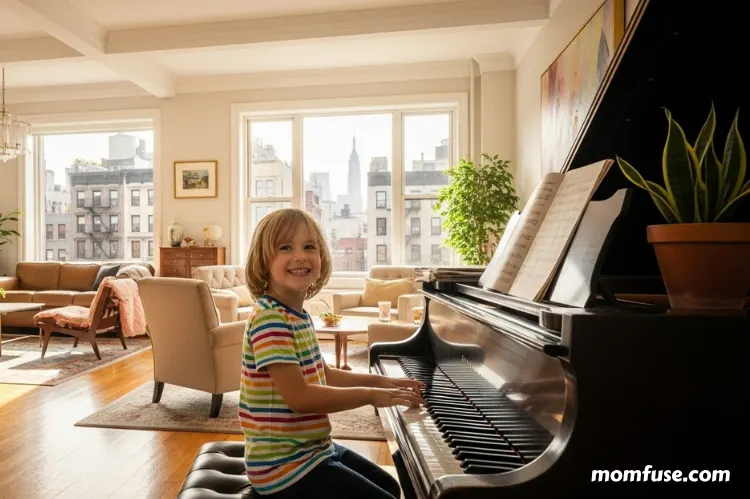

Childhood in New York City can hardly be as leisurely. School days are long, sidewalks are loud and schedules are quickly filled in with tutoring, sports, and enrichment classes that are supposed to prepare kids to succeed.
Piano lessons are a familiar, well-proven option to many families; an option that will open up creativity, discipline, and screen time.
However, after parents choose the option of putting a child in piano, another more subtle question arises: will that be learning in the group or in the one-on-one lessons?
It is not merely about the budget or convenience. With a city as stressful as NYC, the manner in which a child learns is equally important as what he/she learns. Individual and collective piano classes can influence musical development as well as confidence, stress levels, motivation, and effort and feedback experience of a child.
The awareness of the contrast between these two learning styles can enable parents to select a method that is appropriate to the character of their child and emotional and daily-life needs; this way playing the piano becomes a way of balance and development rather than one more object on an already over-saturated schedule.
Understanding Group Piano Lessons

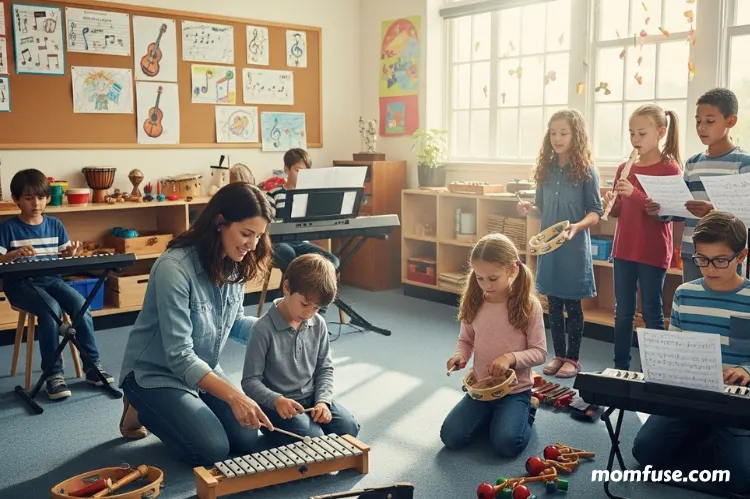
NYC group piano lessons often entail a number of children studying in groups, usually in the classroom. Such programs predominate in NYC music schools, community centers and after-school programs.
Benefits of Group Piano Lessons
1. Social motivation and social learning.
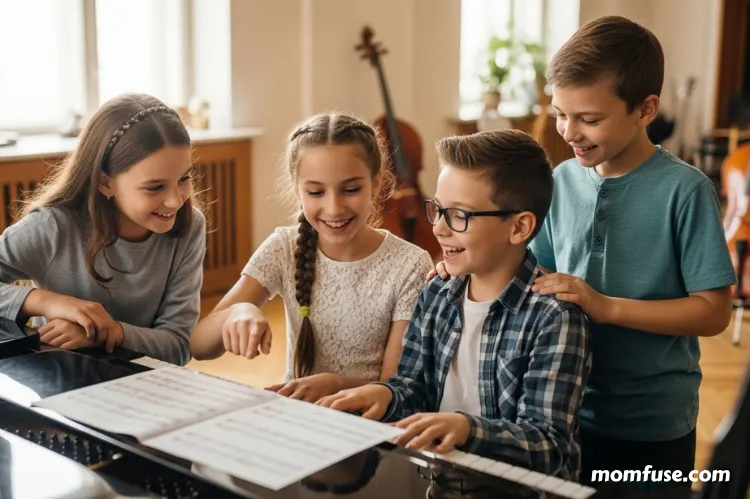
Learning with other children is inspirational and revitalizing to a good number of children. When the peers observe and practice, make mistakes, become better, and succeed, it makes the learning process normal and the concept of progress over time to be reinforced.
The collaboration, listening, and mutual eagerness are also more likely to be developed in a group setting, and younger children are particularly prone to reacting positively to the interactive and cooperative nature of activities.
2. Less Performance Anxiety.

During group classes, the attention will be spread across a number of students instead of given to an individual student. This aids children to become less singled out and feel more relaxed early performance is not as stressful and the fear of making mistakes is lessened. Consequently, students tend to be more inclined to participate, experiment and make creative risks without the burden of being evaluated at all times.
3. Built-in Structure and Routine
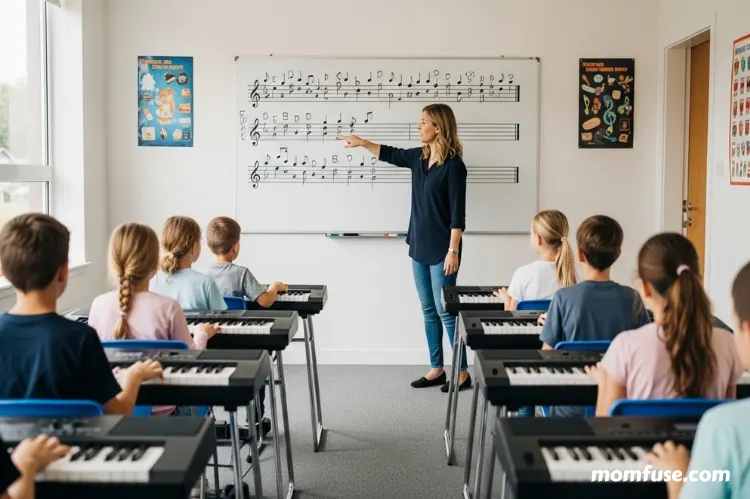
When using providers such as Music To Your Home, group piano lessons will often have a regular curriculum and a regular schedule and this provides a sense of rhythm and predictability which can be very comforting to the families with busy schedules.
4. Cost-effective Option in NYC

New York City is costly in terms of private lessons. Group lessons also tend to be cheaper, and regular music education can be available to more families.
Challenges of Group Piano Lessons

1. Minimized Individualized Attention.
Educators have to pay attention to multiple students. Provided that a child has problems with certain concepts or moves at a different pace, he or she might require additional assistance out of the classroom.
2. Fixed Pacing
Group classes move as a unit. The fast learners might experience a feeling of being held back whereas those that learn slowly might feel rushed.
3. Limited Flexibility
Group lessons tend to have fixed time schedules, which may be difficult in a city where school collections, commuting, and extracurricular activities are already time-consuming.
Understanding Private Piano Lessons
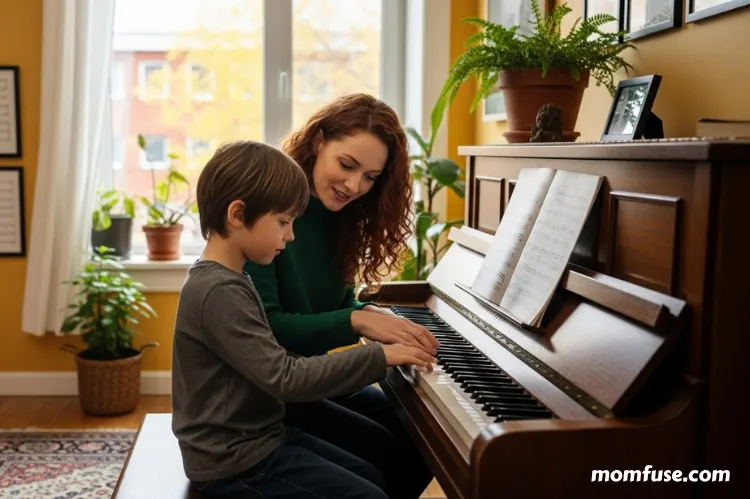
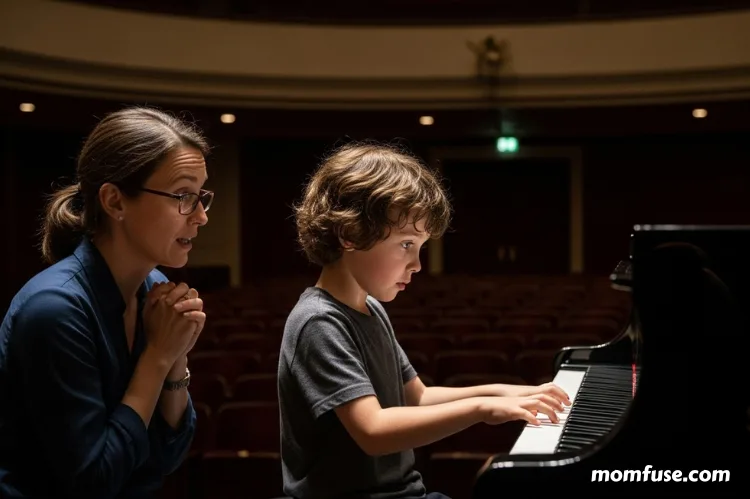
One-on-one lessons include private piano lessons which are fully personalized to your child. These classes will be conducted in studios, in music schools, or right at home, which is a great idea when you have busy families in NYC.
Benefits of Private Piano Lessons
1. Personalized Instruction

All children do not learn identically. In private lessons, the program is tailored to the child and his or her tempo, strengths, and weaknesses, whether he has a problem with rhythm or is advanced in technique.
2. Faster Progress

Children are known to develop faster when given all their attention. Immediately, teachers can correct posture, position of hands, and technique; important in developing a strong foundation.
3. Flexible Scheduling

Flexible hours and the opportunity to fit music education between school, homework, and other activities become the main priorities of many families in NYC as they believe that private lessons are the best variant to receive music education.
4. Positive Teacher Student Affiliation
With time, there is a tendency of the private instructors becoming mentors. This uniformity may increase the confidence and maintain the level of motivation among the kids, even in case of unavoidable plateaus.
Difficulties of the Private Piano Lessons
1. Higher Cost
Individual lessons tend to be pricier especially in Manhattan and Brooklyn.
2. Increased Pressure
Other children are afraid of all the attention directed towards them and are self-conscious, particularly initially.
3. Less Peer Interaction
Otherwise, unless supplemented with recitals or group workshops, without his or her classmates, kids can lose the chance to participate in collaborative learning and get motivated socially.
Matching the Learning Style to Your Child

In choosing between group and individual piano lesson, the following factors should be considered:
Your Child’s Personality
- Social, energetic, and playful?? Group lessons can be more involving.
- Quiet, focused, or easily overstimulated? One-on-one instruction might provide a more relaxed educational experience.
Your Child’s Learning Pace
Learns best by watching others? There is inherent modeling in group classes.
Needs repetition and personalized feedback? One to one teaching can be more effective.
Your Family’s Schedule
The NYC timetables are erratic. The length of school periods, the amount of homework and the time spent in commuting are important. The families also tend to prefer individual lessons to have a more flexible schedule, whereas others like the regularity of the group classes.
Long-Term Goals
Exploration and enjoyment: Group lessons are ideal in terms of introducing music in a low-pressure manner.
Skill development or advanced study: Individual lessons tend to be preferable with children that desire to have a serious progression or learn to take exams and participants.
Can You Combine Both?
Absolutely! And, many NYC families do.
Group piano lessons are common among younger children since in this case, the environment used encourages curiosity, confidence and finding the basics of music in a low stress environment. Once the children become older or have a more advanced interest and dedication, families switch to a more personalized style of education or private lessons.
There are also numerous programs which combine the best of both methods in hybrid forms. These can be in the form of individual teaching with group theory lessons, group experiences, or performance including recitals. This moderate combination offers customized instructions without eliminating teamwork, motivation, and social learning hence it is perfect in all-rounded musical development.
As the lesson design can change as the students develop their skills, interests and determine their level of confidence, there is more likelihood of keeping the student active, encouraged and challenged accordingly. Such a flexible practice can keep the motivation, promote continuous improvement, and make the music both entertaining and significant in the whole process of child learning.
What Matters Most: The Right Environment
Piano lessons can be successful regardless of whether they are administered in a group or during a one-on-one session, but rather than being dependent on the structure of the lesson, they are dependent on the learning environment that surrounds the student. Healthy program gives more focus to growth, motivations and equilibrium to enable students to indulge in music in meaningful and sustainable manner. Look for programs that:
- Promote hard work rather than excellence.
- Allow room for mistakes
- Promote emotional health and competence.
- Make effective communication with parents.
In such a fast-paced city as New York, in particular, the time spent on piano lessons should become a positive and productive area of personal growth. Learning music is a confidence and a source of relaxation when with the right mindset and support system and not an additional burden.
Final Takeaway
The issue of group vs. private piano lessons does not have a universally better answer and instead depends on what is better to your child at this stage.
Group lessons provide a sense of community, cost-effectiveness and motivation. Privacy lessons are more individual, flexible and quicker. The needs of the child may vary as they grow and that is quite normal.
Building a Family Culture of Gratitude and Appreciation suggests that, with the help of straightforward remains, such as gratitude rituals and joint reflections, emotional welfare and good family relationships may be enhanced.
With an understanding of the character of your child, the intensity of his/her stress, and his/her passion, you will be able to select an approach to learning piano that will not only help to develop the musical abilities in your child, but also confidence, concentration, and happiness; all New York City children need to have.
Read Next: Homeschooling Resources to Boost Kids’ Learning

Jessica Fuqua is a mom of two who writes about the messy, beautiful reality of raising kids. She believes parenting advice should feel like a conversation with a friend, not a lecture. When she’s not writing, she’s probably reheating the same cup of coffee for the third time.