
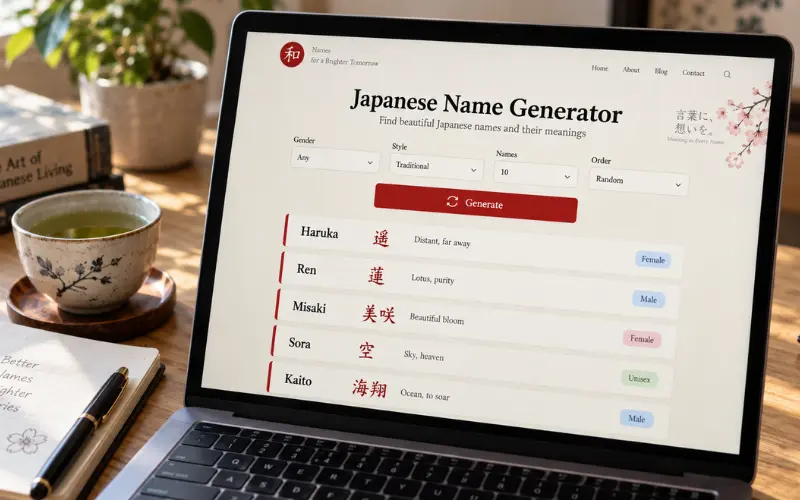

Japanese names put the family name first and the given name second, and almost all of them are written in kanji, where the characters carry meanings of their own. That second layer is why two girls named Yuki in the same classroom can be 雪, “snow,” and 幸, “happiness.” Same sound, different name.
Below: a generator that builds full names with kanji, then 95 real names with their characters and meanings, sorted by girls, boys, unisex, surnames, rare, cool and the dark ones that mostly aren’t real.
Japanese Name Generator
-
Female
Noriko Ogawa 小川 典子
典子 law child 小川 small river
-
Female
Mariko Tachibana 橘 真理子
真理子 truth child 橘 mandarin orange
-
Male
Sosuke Chiba 千葉 蒼介
蒼介 blue, help 千葉 thousand leaves
-
Male
Kichiemon Takahashi 高橋 吉右衛門
吉右衛門 lucky guard 高橋 tall bridge
-
Female
Miyu Furukawa 古川 美優
美優 beauty, gentle 古川 old river
-
Female
Arisa Igarashi 五十嵐 有紗
有紗 have, gauze 五十嵐 fifty storms
No names match that combination.
How Japanese Names Actually Work
A Japanese name is a family name plus a given name, in that order, with no middle name. Japan’s Ministry of Justice limits given-name characters to the jōyō and jinmeiyō kanji lists, a combined pool of roughly 3,000 characters. Anything outside that can be refused at the registry office.
The part that trips up English speakers: the same reading can be written many ways, and the kanji decide the meaning. Aoi can be 葵 (hollyhock), 碧 (deep blue) or 蒼 (pale blue). Parents pick the sound, then pick the characters.
One change worth knowing. Japan’s Revised Family Register Act took effect on 26 May 2025 and now requires parents to register a furigana reading for every name. Unusual readings aren’t banned, but they have to connect to the kanji’s standard usage. Short, clearly-read single-kanji names have climbed since.
Nature imagery runs through the whole system, the same way it does in nature-inspired baby names in English: sun, snow, sky, blossom, harbor, forest.
Japanese Girl Names
Japan’s two big annual surveys both put Sui (翠) at number one for girls in 2025, the first time it has topped either list. Meiji Yasuda Life has run its ranking since 1912; Benesse’s Tamahiyo survey covered 166,011 babies born between 1 January and 15 September 2025.
- Sui (翠) – kingfisher, jade green. Japan’s #1 girls’ name, 2025
- Himari (陽葵) – sun and hollyhock
- Tsumugi (紬) – handwoven silk; suggests connection and persistence
- Rin (凛) – dignified, crisp in the cold
- Mei (芽依) – sprout and reliance
- Hina (陽菜) – sun and greens
- Aoi (葵) – hollyhock
- Kotoha (琴葉) – koto harp and leaf
- Yuzuki (結月) – bind and moon
- Mio (澪) – a channel of water
- Sakura (桜) – cherry blossom
- Hana (花) – flower
- Yui (結衣) – tie and garment
- Yua (結愛) – bind and love
- Akari (明里) – bright and village
- Koharu (小春) – little spring; the warm spell in late autumn
- Riko (莉子) – jasmine and child
- Misaki (美咲) – beautiful bloom
- Yuki (雪 / 幸) – snow, or happiness, depending on the character
- Keiko (恵子) – blessed child; the -ko ending places her mid-century
The -ko suffix is the clearest era marker in Japanese naming. Keiko and Yumiko read as grandmothers now; Riko is the rare modern survivor. If sound matters more to you than heritage, the same logic drives elegant girl names in English.
Celestial picks get their own treatment in our list of Japanese names that mean star.
Japanese Boy Names
The two surveys disagree at the top, which is worth knowing before you trust any single “number one” claim online. Meiji Yasuda put Minato (湊) first for 2025. Tamahiyo put Ao (碧) first for the second year running. Both are single-kanji names, which is the real story.
- Minato (湊) – harbor. Meiji Yasuda’s #1, 2025
- Ao (碧) – deep blue, azure. Tamahiyo’s #1, 2025
- Haruto (陽翔) – sun and soar
- Asahi (朝陽) – morning sun
- Ren (蓮) – lotus
- Yuito (結翔) – bind and soar
- Nagi (凪) – a lull; water gone flat and calm
- Haru (晴) – clear sky
- Sora (空) – sky
- Ritsu (律) – rhythm, law
- Riku (陸) – land
- Sota (颯太) – swift wind and largeness
- Yuto (悠人) – calm, far-off, and person
- Kaito (海斗) – sea and the Big Dipper
- Itsuki (樹) – tree
- Yamato (大和) – great harmony; the ancient name for Japan itself
- Haruki (春樹) – spring and tree
- Daiki (大輝) – great radiance
- Kenji (健二) – healthy and second son
- Takeshi (武) – warrior
The kanji 翔 (shō, “to soar”) has been the most-used character in boys’ names for five years running, helped along by Shohei Ohtani.
Unisex Japanese Names
Japanese has no legal gender marking on names, so the unisex category is genuinely large rather than a modern invention.
- Akira (明) – bright, clear
- Hikaru (光) – light
- Kaede (楓) – maple
- Tsubasa (翼) – wings
- Shion (詩音) – poem and sound
- Kohaku (琥珀) – amber
- Rei (零 / 麗) – zero, or lovely
- Nao (直) – honest, straight
- Makoto (誠) – sincerity
- Chiharu (千春) – a thousand springs
- Kaoru (薫) – fragrance
- Michi (道) – path, the way
For the English-language equivalents, see our non-binary and gender-neutral names list.
Japanese Last Names
Japanese surnames are mostly landscape descriptions. Someone’s ancestors lived at the base of a mountain, or by a bridge, or in the middle of a rice field, and that became the family name.
- Sato (佐藤) – helper and wisteria. Japan’s most common surname
- Suzuki (鈴木) – bell and tree
- Takahashi (高橋) – tall bridge
- Tanaka (田中) – middle of the rice field
- Watanabe (渡辺) – the crossing place
- Ito (伊藤) – another wisteria name
- Yamamoto (山本) – base of the mountain
- Nakamura (中村) – middle village
- Kobayashi (小林) – small forest
- Kato (加藤) – wisteria again
- Yoshida (吉田) – lucky rice field
- Yamada (山田) – mountain rice field
- Sasaki (佐々木) – the 々 mark repeats the character before it
- Shimizu (清水) – pure water
- Hayashi (林) – forest
The 藤 character in Sato, Ito and Kato marks a historical link to the Fujiwara clan, which is why it shows up so often.
Rare Japanese Names
These are real registry names, not inventions, but uncommon enough that a Japanese speaker would notice them.
- Nazuna (薺) – shepherd’s purse, one of the seven spring herbs
- Ibuki (息吹) – breath, life force
- Towa (永遠) – eternity
- Shiori (栞) – a bookmark
- Kanata (彼方) – far off, the other side
- Sumire (菫) – violet
- Nagisa (渚) – the water’s edge
- Utano (歌乃) – song
- Rihito (理人) – reason and person
- Isamu (勇) – courage
If rarity is the whole point, our rare names with deep meaning list runs the same test across other languages.
Cool Japanese Names
“Cool” does specific work in Japanese: single-kanji names land harder, and weather imagery carries edge.
- Jin (仁) – benevolence. One syllable, Confucian weight
- Arashi (嵐) – storm
- Raiden (雷電) – thunder and lightning
- Hayate (疾風) – gale
- Shinobu (忍) – endurance, stealth. The same character as in shinobi
- Ryo (涼) – cool, refreshing. Literally cool
- Musashi (武蔵) – an old province, and the swordsman
- Taiga (大河) – great river
- Homura (焔) – blaze
- Hayato (隼人) – falcon and person
- Ginji (銀次) – silver
- Ryunosuke (龍之介) – dragon, plus a classical name ending
Storm names translate well across languages; see our names that mean lightning for the wider set, and space and celestial names if the sky angle appeals.
Japanese Names With Dark Meanings, and Which Ones Are Fake
Most “dark Japanese names” lists online are anime inventions presented as registry names. Here’s the split.
Real names with dark or dusk-toned imagery:
- Kasumi (霞) – mist, haze
- Shizuka (静) – quiet, still
- Akane (茜) – madder red, the colour of dusk
- Yoru (夜) – night. Rare but genuinely used
- Sumi (墨) – ink
- Mikazuki (三日月) – crescent moon
Fiction only, not registered names: Yami (闇, “darkness”), Kage (影, “shadow”) and Kuro (黒, “black”) circulate widely on name lists. They’re characters and nicknames, not names Japanese parents register. Use them for a story, not a birth certificate.
The English equivalents that are real are collected in our names that mean dark list.
Do Japanese Names Work in the United States?
Some already do. Social Security Administration data for 2025 shows Kasai, meaning “fire” in Japanese, entering the US top 1,000 for the first time at #639, a jump of 1,108 places in one year. Akari was among the fastest-rising boys’ names in the same release.
The names that travel best share a pattern: two or three syllables, no long vowels, and a spelling that survives an American substitute teacher. Kai, Rin, Mei, Sora, Hana and Ren clear that bar. Ryunosuke and Yuudai don’t, which is fine if you’re naming within a Japanese-speaking family and a problem if you aren’t.
Quick Answers
What is a random Japanese name?
A random Japanese name pairs a surname with a given name, family name first: Tanaka Haruto, Suzuki Mei, Kobayashi Ren. The generator above draws from real registered names rather than invented syllable combinations, so every result is a name someone in Japan actually has.
How do I create my Japanese name?
Pick the sound first, then the characters. Choose a reading you can pronounce, then select kanji whose meaning you want the name to carry. For converting an existing English name, the standard approach is katakana transliteration: Emma becomes エマ, Michael becomes マイケル.
What is the rarest Japanese name?
There’s no single rarest name, because kanji variation splits the counts. Among names still in circulation, Nazuna (薺), Towa (永遠) and Utano (歌乃) are genuinely uncommon. Rarity in Japan usually comes from an unusual kanji choice, not an unusual sound.
What is a pretty Japanese girl name?
Sakura (桜, cherry blossom), Aoi (葵, hollyhock), Himari (陽葵, sun and hollyhock), Sumire (菫, violet) and Koharu (小春, little spring). Flower and light imagery dominates the pretty register, and all five read cleanly in English.

MomFuse publishes baby-name guides for parents who want the meaning to actually be right. Every name is checked against Behind the Name, national birth registries and original-language sources, and anything that cannot be verified gets cut.